
Compare Perry County Property Value Types
Not every number means the same thing. Perry County value fields answer different questions: Delta appraisal cards can show land, building, total, and assessed figures for one parcel, a deed may state consideration, and an appraisal is its own opinion. That opinion is professional and tied to a single date and purpose.
| Value | What It Is | Where |
|---|---|---|
| Assessed value | True value multiplied by the Mississippi class ratio | Delta appraisal and tax detail |
| True or market value | Mass-appraisal estimate used in the tax system | Assessor record |
| Recorded consideration | Transfer amount or value, which may not equal market price | Recorded deed detail |
| Land and improvements | Separate components supporting total value | Delta parcel card |
Mississippi assesses on a ratio: Class I owner-occupied residential real property at 10 percent of true value, most other real property at 15 percent. The gap explains why assessed value sits below the tax system's true-value estimate. It never predicts what a buyer will pay.
Look Up Perry County's Assessed Value
Use the Delta Property Appraisal form to pull a Perry County tax card. It takes a name, address, parcel, or PPIN. Start with the exact key, open the matching card, and save the tax year beside every value you copy.
- Search by address, parcel or PPIN and confirm the owner and legal description.
- Record land, building, total and assessed figures with the tax year.
- Check property class before interpreting the assessment ratio.
- Use recorded transfers only as dated context, not a current appraisal.
- Assessed value
- The tax-base figure after applying the class ratio.
- True or market value
- The assessor's mass-appraisal estimate.
- Assessment ratio
- The class percentage converting true value to assessed value.
Know What Perry County Property Value Cannot Prove
An assessor figure exists for taxation. Mass-appraisal rules build it, so it can miss the date, condition, repairs, financing, or negotiation behind a single transaction. That is why it may differ from an offer. Recorded consideration can also mislead in a family, quitclaim, or other non-arm's-length transfer.
Value versus price. Perry County assessed value is used for taxation. It is not a sale-price promise and is not a licensed appraisal.
Read Perry County Land and Building Values Together
The sample Delta parcel card dates every field. PPIN, parcel, owner, legal description, and section-township-range sit beside values, building fields, land-use code, and sketch access, all tied to a tax-year label. Together those fields anchor the value.
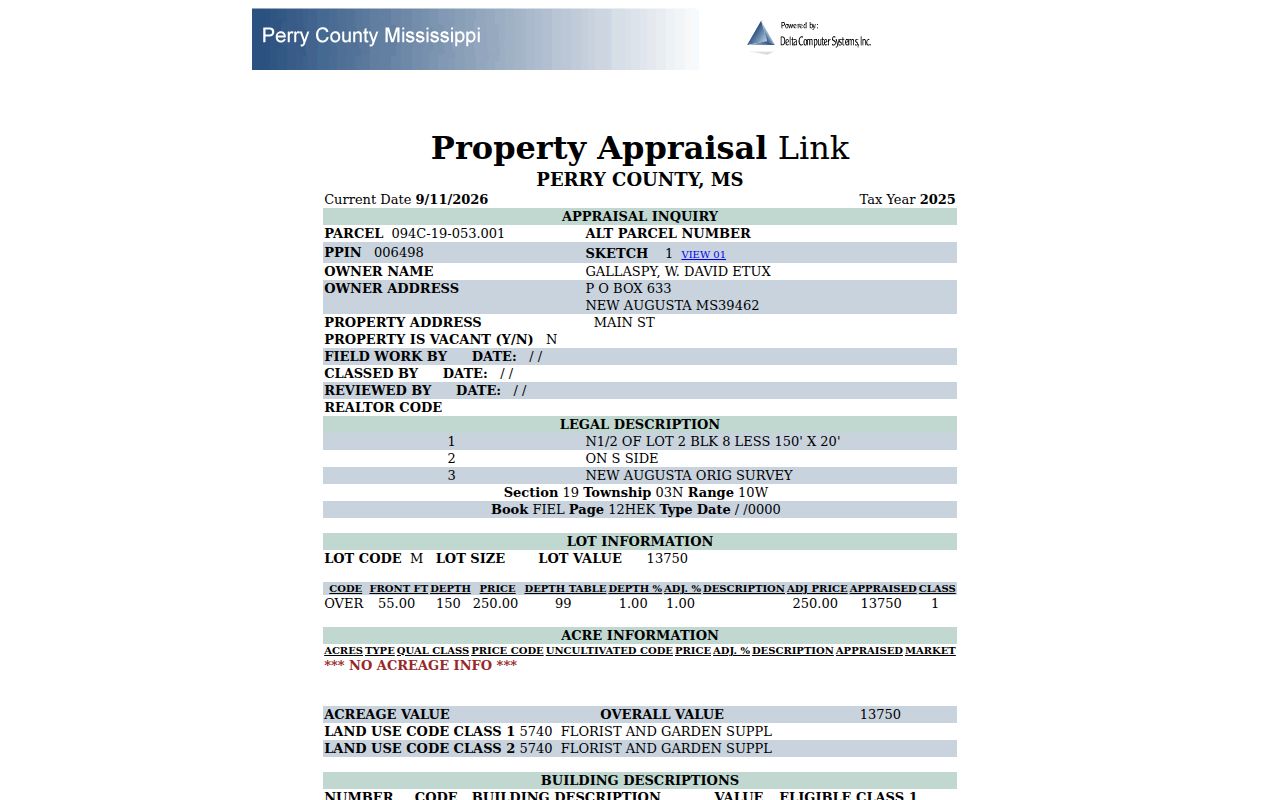
The card makes the point plainly. Land and improvement components, class, and tax year should travel with the assessed value rather than ride along as one bare number stripped of context.
Apply Mississippi Ratios to Perry County Values
The Mississippi Department of Revenue appraisal guidance spells out the formula and each class. Class I is single-family, owner-occupied residential real property. It is assessed at 10 percent of true value. Class II covers most other real property at 15 percent. Class III personal property also sits at 15 percent. Class IV public-utility property and Class V motor vehicles are assessed at 30 percent.
Confirm the class before applying a ratio. Appearance is not enough for mixed use, vacant land, or a parcel whose occupancy changed.
Note: The ratio converts true value to assessed value for taxes. It does not discount what a Perry County parcel would likely sell for.
Separate Perry County Value From Tax Charges
Delta tax detail can show county, city, and school charges, plus paid and balance fields, assessed value, parcel, and tax year. Those charges come from assessment, millage, and credits. They are not separate estimates of worth. Homestead status can shift the taxable result without moving every underlying value field the same way. Bill payment, exemptions, delinquency, and appeals belong to the Tax Assessor/Collector and the property-tax record. Keep them out of this value comparison.
Use Perry County Deed Consideration as a Clue
Consideration appears among the Official Records Inquiry criteria, but a displayed amount needs context. A warranty deed from an arm's-length sale says more than a quitclaim, trustee, tax, executor, or family transfer. Such a deed reflects a real exchange. Even a genuine price reflects one property on one market date.
Match grantor, grantee, and legal description to the parcel first. A mortgage or deed of trust is not a sale price. A partial-interest deed may not represent the whole tract.
Compare Perry County Property Value by Place and Use
Richton, Beaumont, and New Augusta are incorporated places. Their ZIP labels also serve rural areas. Check the GIS municipal-boundary layer before treating the mailing town as a market boundary. Compare similar land-use codes, building facts, acreage, and geography. Perry County holds broad forested, rural land shaped by roads, the Leaf River, and Black Creek. A nearby parcel can be a poor comparison when access, flood context, services, use, or improvements differ. The county offers no public parcel-specific comparable-sales export, so do not treat the portal as a professional comp set. Choose comparisons carefully.
Date Every Perry County Property Value Finding
Save the access date, tax year, PPIN, parcel, legal description, land value, improvement value, total or true value, assessed value, and class. County notices and vendor records change over time. Ask the Tax Assessor/Collector about blanks rather than guess. A purchase, estate division, or other market-sensitive decision needs a licensed appraisal based on the parcel and an effective date. Public value records still serve tax context. They also support broad comparison. State their purpose and limits.
Resolve a Perry County Value Record Conflict
Copy both source dates first. When the appraisal card and the tax detail disagree on a year or a figure, the Perry County Tax Assessor/Collector is the office to call. Have the details ready. That means the PPIN, parcel, situs, class, legal description, and disputed fields. Ask which roll year controls. Also ask whether a correction or a newer assessment exists for the parcel. Do not solve a conflict by picking the larger number. Delta is county-linked but carries an update-lag warning, and a saved result can age. A narrow Mississippi Public Records Act request can seek a specific assessment record, a methodology document, or a copy, with questions about fees, format, and any redaction.
A recorded consideration conflict is different. Note the deed type, date, parties, and whether the whole parcel transferred, because the Chancery Clerk answers for the recorded instrument while the assessor explains tax values. Each office answers a different value question.
Build a Perry County Property Value Evidence Sheet
Label every number with its year and source. A solid evidence sheet holds the PPIN, parcel, owner of record, situs, legal description, property class, land value, improvement value, total or true value, assessed value, tax year, and access date. If the Delta detail lists county, city, or school charges, keep those in a separate tax column. They are taxes, not value.
Match before you add a deed. A recorded transfer belongs on the sheet only after its parties and legal description line up with the same tract. Note the instrument type, file date, consideration, and whether it covered the entire parcel. Quitclaims, family transfers, executor deeds, trustee deeds, and tax deeds can carry circumstances that make consideration a weak market indicator. A mortgage principal is not a sale price.
Compare uses and physical facts, not the nearest address. Acreage, improvement type, land-use code, road access, flood setting, municipal services, and condition can make adjacent Perry County parcels unlike. The county GIS helps check geography. It does not appraise improvements or establish a legal boundary.
State the question first. An assessed value explains the tax base. A deed consideration documents a historical transfer. Neither one says what a buyer would pay today. A licensed appraiser can inspect the property, select and adjust market evidence, and give an opinion for an effective date. Keeping those purposes separate stops a precise-looking public number from carrying more weight than its record supports.
Mississippi sets January 1 as the ownership and status date for local appraisal guidance. That single date explains a lot. A later physical change, occupancy change, or transfer may not line up with the roll you are viewing. Confirm the controlling year and classification with the assessor. Some changes belong to a later cycle. A data correction follows a different path. Never invent a reassessment schedule or effective date that the Perry County source does not state.