
Deed Types in Perry County's Recorded Index
Deeds in Perry County are recorded by the Chancery Clerk. The clerk also keeps the land indexes. The instrument list in the portal separates true conveyances from debts, releases, and notices. Start with the type that matches the event. Then read the document itself before deciding what legal interest actually changed.
| Recorded type | What it signals | Research use |
|---|---|---|
| Warranty Deed or Land Deed | A recorded conveyance with deed language | Ordinary transfer trail |
| Quit Claim Deed | Conveys the interest described, without proving a clean chain | Family, estate, or corrective trail |
| Executor, Administrator, Commissioner, or Trustee Deed | A fiduciary or court-linked conveyance | Estate, court, or foreclosure context |
| Tax Deed and Land Redemption | Distinct steps in delinquent-tax research | Sale and redemption questions |
| Mineral, Partition, or Timber Deed | A defined estate or divided interest | Rural land and severed interests |
A Deed of Trust, Mortgage, Construction Lien, Lis Pendens, Judgment, Easement, Right of Way, or Release can affect a parcel without serving as the buyer's deed. Keeping those categories apart is half the work in a Perry County deed records worksheet.
Open Perry County Official Records Inquiry
The Perry County Official Records Inquiry opens to the public once its terms are accepted. Search All, Grantor, and Grantee modes are available. A matched-name option, full-name entry, date ranges, and shortcuts to recent filings are also offered. Begin with the broadest party search that makes sense. If the expected Perry County deed records do not surface, run the same name through the other role.
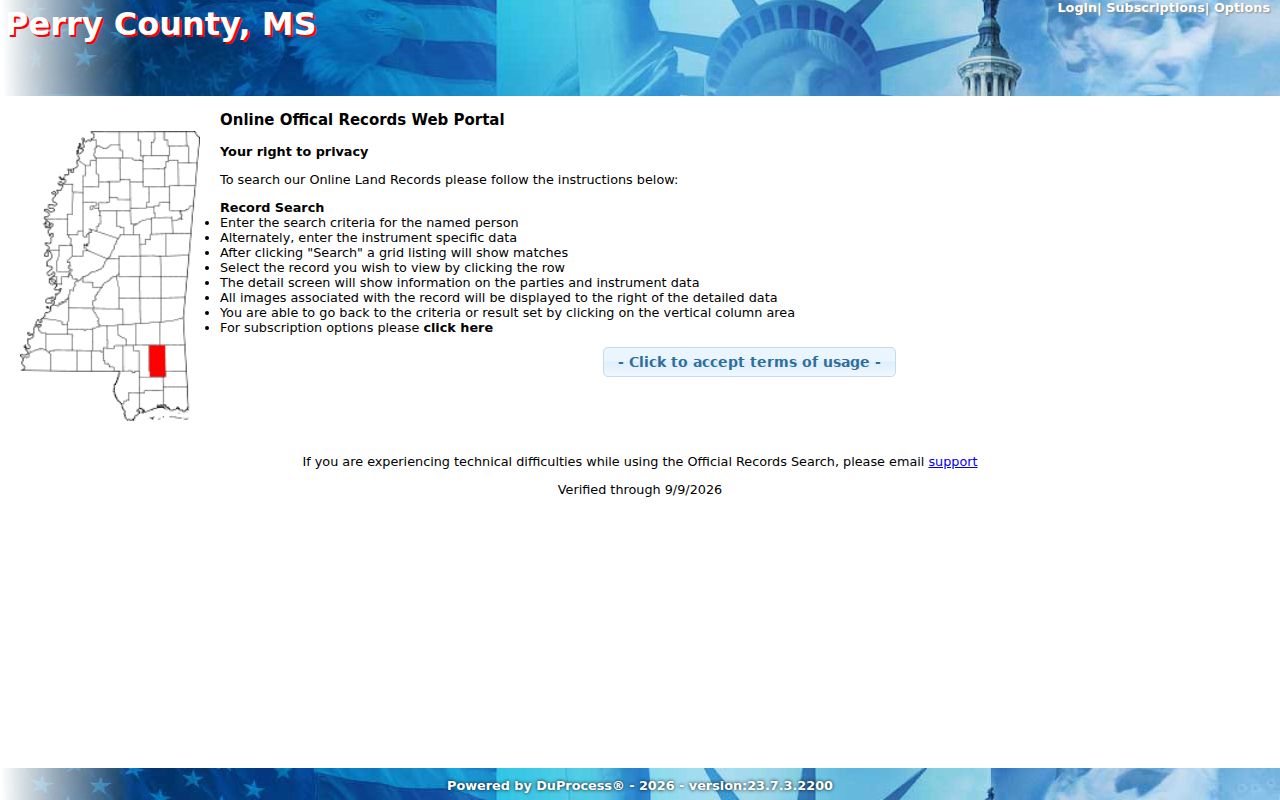
Treat the screen as an index entry point rather than a title certificate. Save the spelling, role, filters, and access date so the search can be reproduced if its result later changes.
Perry County Deed Records Offer Deep Property Filters
Party names are only one route in. The instrument criteria cover year and number, volume, type, book, page, legal description, parcel ID, consideration range, and subdivision. Beyond those, filters reach block, lot, section, township, range, quarter, street name and number, parcel, and PPIN.
| Search group | Fields displayed | When it helps |
|---|---|---|
| Party and date | Search All, Grantor, Grantee, matched name, begin/end, recent periods | Transfers associated with a known person or entity |
| Instrument | Year/number, type, volume, book/page, consideration | A citation or transaction type is known |
| Legal land | Subdivision, block/lot, section-township-range, quarters | Names vary but the land wording persists |
| Address and identifier | Street, number, parcel, PPIN | A Delta card supplies a firm property key |
Those controls earn their keep with initials, suffixes, estates, trusts, and business names. The subdivision choices also preserve the exact search vocabulary for named additions in Beaumont, New Augusta, and Richton.
Follow Perry County's Grantor-Grantee Trail
A grantor conveys the interest; a grantee receives it. Start with the most recent likely conveyance. Verify its property description. Then search that grantor as a grantee in an earlier window. The land itself, not a shared surname, is what ties the steps together.
- Find the present candidate owner's acquiring deed with that party shown as grantee.
- Copy the grantor, legal description, subdivision, block and lot, book/page, instrument number, and filing date.
- Search the grantor as an earlier grantee and accept the link only after the land descriptions agree.
- Note trusts, releases, probate orders, tax deeds, or name changes that interrupt a simple sequence.
- For an older gap, ask the Clerk about the controlling index or book and use MDAH finding aids.
- Grantor
- The party conveying the described interest.
- Grantee
- The party receiving that interest.
- Chain of title
- The linked sequence of conveyances for the same land.
- Book/page and instrument number
- Separate index references used to locate a recording.
A New Augusta Result Explains Perry County Index Detail
One example shows how detailed a result can be. A surname search covering 2020 through 2026 returned a 2021 quitclaim deed listed as instrument 202100728, book 204, page 620. The entry carried parties, a March 31, 2021 filing date, New Augusta Original, block 8, and a verified/original status label. A second sample showed a 2022 warranty deed in New Augusta Original, block 10, lot 3.
These illustrate result structure, not present title. Preserve status labels exactly as displayed. Inspect any related instrument rather than treating a cross-reference as proof on its own.
Read Perry County Deeds Beside Liens and Releases
The portal can also surface a Deed of Trust, Assignment, Partial Release, Release, Cancellation, Construction Lien, Federal Tax Lien, Judgment, Lis Pendens, or Transfer of Lien. Search the parties around a transfer date. But never mistake a debt document for an ownership transfer. Match every release to the obligation it claims to affect.
Tax-sale work carries its own vocabulary. A notice or auction listing does not prove title changed. Look for Tax Deed and Land Redemption instruments. Then ask the Chancery Clerk for current status. Foreclosure notices may instead point to a Trustee's Deed. Similar sale language does not make these paths interchangeable.
The 1900 Perry County Date Does Not Promise Completeness
The portal's oldest-file endpoint reports January 1, 1900. That date is a clue. It is not a coverage guarantee. The system makes no promise that every Perry County deed from that date forward is indexed. It does not promise that each one is imaged. Coverage gaps are real.
The MDAH Perry County finding aid catalogs county material from 1862 through 1977. The series includes historical land, tax, court, and ownership-map sources. When a gap appears, note the parties, land description, approximate dates, and last book reference. Ask the Clerk which index comes next, then request the relevant archive series or microfilm. Newspapers and library collections add context but cannot replace the deed book.
Request a Perry County Deed Copy
A selected record can expose image-viewer, PDF, cart, and certified-copy controls. No dependable current price for images or certification is published, so gather the details first. Note the instrument number, book and page, parties, date, and the format you want. Then contact the Perry County Chancery Clerk at 103 South Main Street, New Augusta, Mississippi 39462, P.O. Box 198, or 601-964-8398.
Ask whether the image is online. Ask whether a plain or certified copy fits your need. Ask what fee applies. Ask which payment method is accepted. The county page states that listed Clerk transactions do not take card payments. It points to cash, check, or money order, but confirm current procedure before sending funds. A narrow written request can also seek a fee estimate under the Mississippi Public Records Act.
Recorded, not guaranteed. Perry County deed records show what entered the public index. They are not a survey or title opinion, and unrecorded interests may exist.
Use the Perry County Clerk When the Screen Stops Short
A blank result means "not located in the source searched," never "no deed exists." Run the name again exactly. Then run it loosely. Try both party roles. Add dates, instrument types, parcel or PPIN, subdivision, and legal terms. Keep track of whether the system returned zero rows or threw an error. That difference matters. When the index still comes up empty, give the Chancery Clerk the full picture: every name variant, the address, the parcel or PPIN, the legal description, the target period, the record type, and the copy format you want. Probate, guardianship, divorce, partition, or a chancery order can explain a fiduciary transfer. A judgment question may also pull the Circuit Clerk in. That documented fallback beats forcing an incomplete set of Perry County deed records into a confident chain.
Document the Perry County Deed Chain Without Guessing
Build the chain one instrument at a time. Keep the portal's own wording for every line you enter. Cover both parties and their roles, the instrument type, filing date, and instrument number. Add book and page, page count, and document status. Include any related instrument, and list the consideration exactly as displayed. Record the subdivision, block, lot, and parcel, plus the full legal description. A sound transfer chain needs continuity of the land itself, not just repeated surnames.
Label each link confirmed, probable, or unresolved. A shared last name proves little on its own. A matching subdivision and block, or the same section-township-range, carries more weight. The strongest signal comes when the current Delta card repeats the same PPIN or legal text. A parcel split, correction, partition, probate order, or tax deed may reword the description. If that happened, place the old and new versions side by side. Then ask the Clerk for whatever document bridges them.
Book families help you avoid missed results. Land Deed, Mortgage, Lis Pendens, Tax Release, Wills, Chancery Court Minutes, Circuit Court Minutes, Oil and Gas, Construction Liens, and Homestead Chargeback are separate choices. Each gets its own option on the portal. Start with the broad instrument type. Test a specific book family when the event points there. Never assume a will conveyed land just because it names property. The Clerk notes that wills reach probate only when filed in an estate. The estate or fiduciary deed may then close the public trail.
Log every negative search with its exact settings. Write down the spelling, role, range, type, and land filters. Note whether the portal returned zero rows or failed. Retry spelling variants, and ask whether the book or year even exists in the online system. That habit preserves the gap between not located and nonexistent. The distinction matters for Perry County deed records because their online completeness is undocumented.