
Trace Former Perry County Owners by Transfer
A former-owner chain begins with the newest located conveyance and moves backward by party name and land description. The Perry County Official Records Inquiry reports an oldest file date of January 1, 1900, but the county has not confirmed complete indexing or images from that date. MDAH finding aids identify Perry County government holdings from 1862 through 1977, so the archive route matters when online results thin out.
| Source | Years It Covers | Where Held | What It Shows |
|---|---|---|---|
| Official Records Inquiry | Portal reports 1900 forward | Chancery Clerk portal | Parties, instruments, dates, book/page and legal fields |
| Deed books and Clerk files | Coverage confirmed per book | Chancery Clerk | Earlier conveyances and recorded descriptions |
| MDAH county records | Finding aid spans 1862-1977 | Archives and microfilm route | Land, tax, court and ownership-map series |
| Library and newspapers | Varies by collection | Local research collections | Context, notices, names and date clues |
Start online for a recent chain, then ask the Clerk about the book or year that disappears. For a nineteenth- or early twentieth-century question, consult the MDAH Perry County finding aid before assuming that an empty portal result means no deed existed.
Reconstruct Perry County's Deed Chain Backward
The Official Records Inquiry accepts party, instrument, book and page, legal-description, parcel, PPIN, subdivision, block, lot, and section-township-range criteria. Those keys prove each prior deed concerns the same land. A shared surname alone proves nothing. The public index entry page presents a terms acceptance step before the search controls appear.
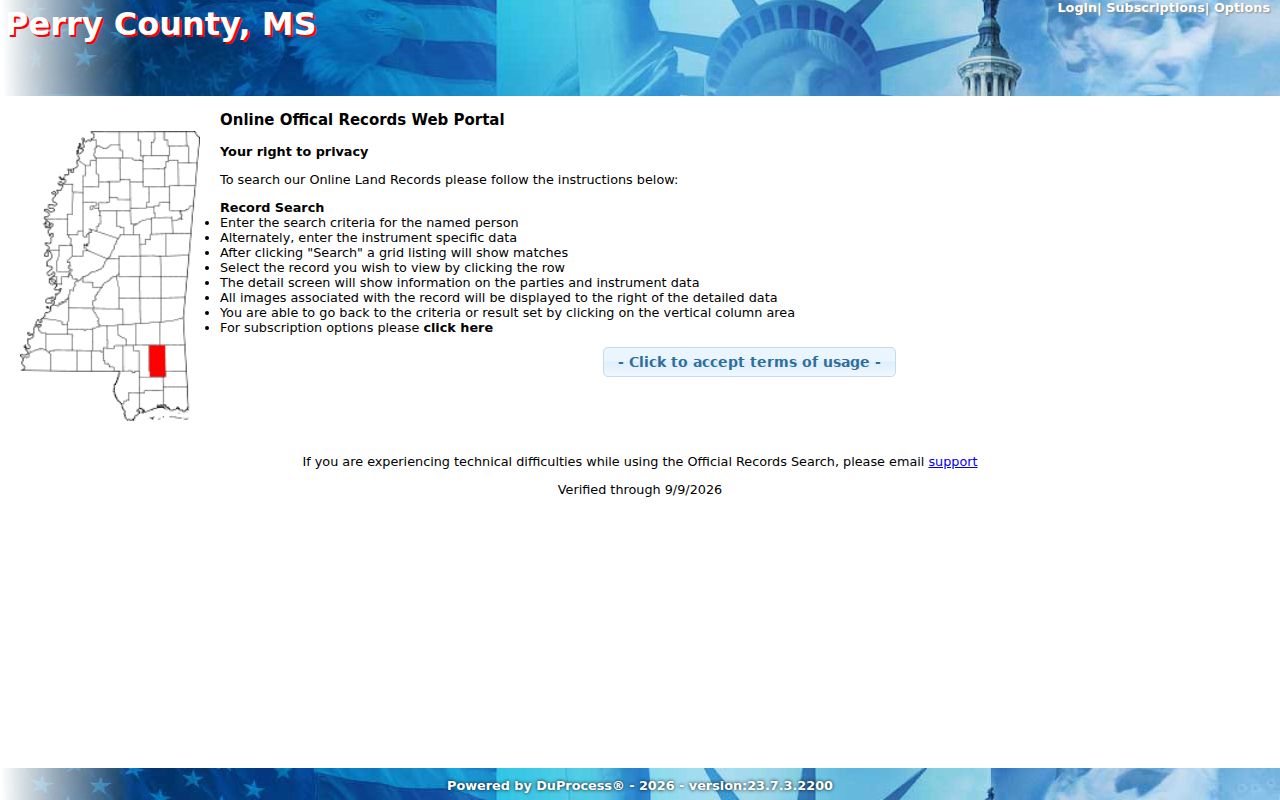
The captured entry screen marks the gateway to the party and instrument search used for each backward step.
- Locate the current acquisition deed and record its date, instrument type, parties, book/page and legal description.
- Take the grantor from that conveyance and search that person or entity as a grantee.
- Match the land through legal wording, subdivision, block/lot or section-township-range, then repeat.
- When the index stops, carry the last firm book/page and name to the Clerk or MDAH.
- Grantor and grantee
- The transferring and receiving parties shown on a deed.
- Reverse index
- A party index used here to trace each grantor back to an earlier acquisition.
- Chain of title
- The ordered sequence of instruments affecting the same property.
- Warranty and quitclaim
- Different conveyance forms whose legal effect should not be assumed from a result label alone.
How Far Back Perry County Former Owners Go
The defensible answer depends on the actual book, series and image availability. The portal's 1900 lower-bound response is not a completeness promise. MDAH lists older Perry County materials. These include historical land and tax series and an ownership-map listing. The Perry County Library genealogy collection adds microfilm, newspapers, obituaries and local indexes as supporting clues. Those sources do not replace deeds.
Coverage limit. Online former-owner results reach only as far as the indexed book and image set. Confirm older volumes with the Clerk or archives.
Build a Perry County Former-Owner Worksheet
Give each transfer its own row rather than a loose list of surnames. For every deed, record the transfer date, grantor, grantee, deed type, instrument number, and book/page citation. Add the consideration if the deed displays it. Add the subdivision or section-township-range and the exact legal description. A source label helps too. Note whether Recorder portal displays, Clerk copy states, or MDAH finding aid lists each detail.
| Transfer date | Grantor to grantee | Deed type | Book/page |
|---|---|---|---|
| Newest located | Current grantor to current grantee | Verify as conveyance | Copy exactly |
| Prior step | Earlier grantor to later grantor | Verify as conveyance | Match the same land |
| Archive step | Earlier parties | Read original label | Request named volume |
That structure exposes gaps and parcel mismatches early.
Separate Perry County Conveyances From Other Instruments
A deed of trust secures debt. A release may clear an earlier instrument. A lien or lis pendens signals a claim or dispute, and these papers can matter to the ownership story even though their parties never held title. The names still belong in your timeline.
Read the instrument type before advancing the chain. Trustee, tax, executor, and administrator deeds can mark genuine transfers while pointing toward foreclosure, redemption, or probate files. Search those connected records when the sequence looks unlike an ordinary sale.
Note: A zero consideration amount or a quitclaim label alone does not prove that no ownership interest changed.
Follow Perry County Legal Descriptions Through Time
Older records often omit a modern street address. Compare subdivision, block, and lot for platted land. Use section, township, range, quarter calls, and metes-and-bounds language for rural tracts. Keep parcel and PPIN strings exact. The county publishes no official decoder for them.
A split, merge, or partial conveyance can make a chain branch. Acreage, lot calls, or boundary language can change over time. Stop and determine whether the deed conveyed the whole tract. The county GIS map can orient today's parcel. It cannot repair a broken historical description.
Bridge Perry County Estate and Court Transfers
Death changes the pattern. When a former owner died, the next name may arrive through probate. It may not arrive through a purchase deed. The Perry County Chancery Clerk handles estates, wills, and guardianships. Executor, administrator, and fiduciary terms should send you into the court file. Hunt there for any later deed.
Divorce, partition, guardianship, and judgment records explain other jumps. The Circuit Clerk keeps the judgment roll. Chancery handles many equity and property matters. Treat a case as context until a deed or order clearly touches the parcel.
Take Older Perry County Ownership Research Offline
When a book or year goes missing, contact the Chancery Clerk with the last known party, book and page, approximate date, and legal description. Ask whether the volume sits at the counter, is imaged, rests on microfilm, or has been transferred elsewhere. The office displays no image or certified-copy prices online. Request a current estimate.
The MDAH genealogy route and the Perry finding aids help identify archive series before a visit. Newspapers and local files supply spelling clues. Label them as supporting sources. This work suits house history, inheritance, and property diligence, and it must never be used to track or harass a living person.
Handle an Empty Perry County Former-Owner Search
Zero online rows do not prove that no transfer occurred. Note the portal you used. Note the spelling and date range too. Note the instrument filters, parcel or PPIN, and legal terms. Repeat the search with name variants and a broader range. Then ask whether the relevant book or year is indexed online at all.
A deed may sit under a fiduciary, an entity, or an earlier land description. Follow connected probate or court records when those clues appear. If the trail stays unresolved, say that no record appears in the named source. Do not declare that a former owner never held the property.
Use Perry County History Without Replacing the Deed Chain
Perry County was organized in 1820. Its usable records start later, and on different dates. That gap matters more than most searchers realize. A founding year is not the first deed date. A portal's lower bound does not mean its images are complete. The MDAH Perry finding aids describe government records from 1862 through 1977. They cover land, tax, court, and ownership-map material. Cite the collection and series identifiers when you request an older volume.
New Augusta is the county seat. References to Old Augusta, or to community names that shifted over time, can yield strong search terms. Richton and Beaumont carry their own addition and subdivision vocabulary. A tract under a town ZIP may still be rural land. Search the land description and the recorded subdivision name instead of forcing a modern postal label backward.
Local newspapers shine around trustee sales, foreclosure notices, tax sales, and estate notices. A notice can hand you a date, a party, a sale place, and a legal description. That description points back to the recorded instrument. It cannot prove the final owner of record after sale, redemption, or later conveyance. Record the publication, the issue date, and the exact URL or page. Then return to the Clerk's records.
The library genealogy room offers microfilm, census records, newspapers, and obituaries. These help reconcile spellings and family identity. Treat all of it as supporting evidence. An obituary or directory listing never establishes title to a parcel. The deed chain stays the spine. Probate orders, tax instruments, plat maps, and historical sources explain only the steps they actually document.